
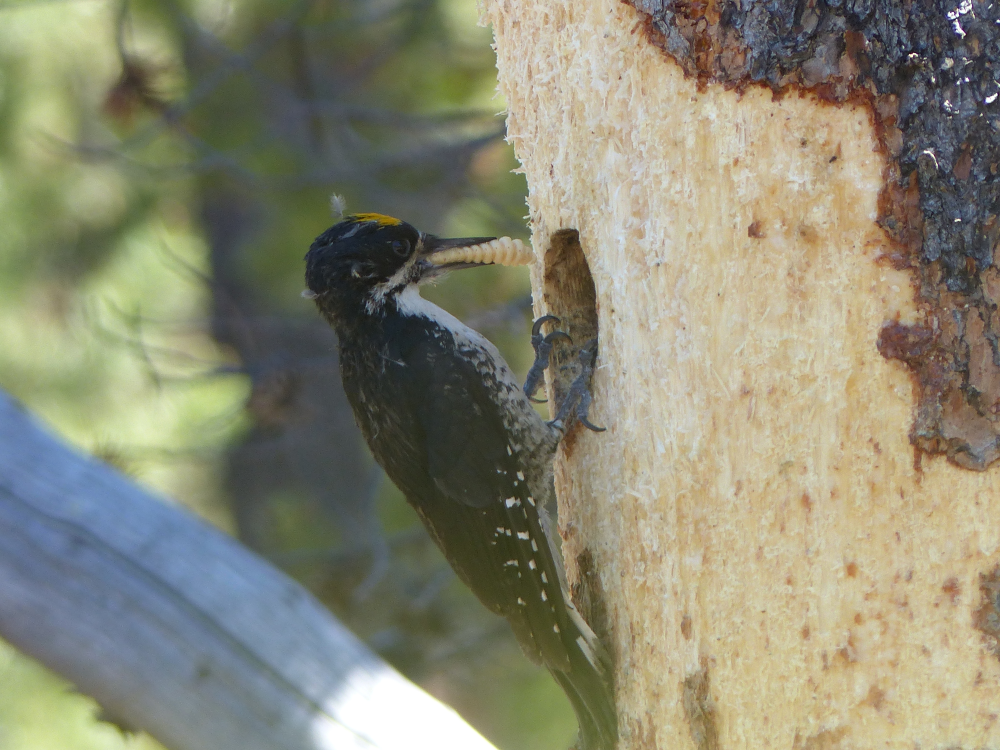
Photo courtesy of Yaquina Birders & Naturalists
The Black-backed Woodpecker is typically considered a post-fire associated species. However, it was recently discovered that this woodpecker is nesting successfully in old lodgepole pine forests in the western portion of its range. This talk by Mark Kerstens will explore some of the natural history of this important woodpecker, and how its dual habitat associations tie together to teach us lessons about historical forest conditions and wildfire, and what this means for contemporary forest management, wildlife, and communities in our fire-adapted landscapes.
Mark earned a B.S. in Biology from the University of Massachusetts, Amherst. His honors thesis studied how overwintering birds in mixed-species flocks respond to pishing vs. chickadee mobbing calls. He has since spent several years on avian point count and nest monitoring projects in Oregon punctuated by teaching outdoor education in southern California. His main research interests are how to manage forests both before and after wildfires to provide habitat for cavity-nesting birds, and to use these species as indicators for ecosystem health. For his M.S. he studied Black-backed Woodpecker vital rates in fire-prone landscapes, and he has been expanding work on that species for his Ph.D. When not chasing birds, Mark likes to spend his time climbing/skiing volcanoes, trail running, mountain biking, or sewing his own outdoor gear.
MEETING LOCATION:
OSU Extension Lincoln County
1211 SE Bay Blvd
Newport, OR 97365
This presentation is brought to you by Yaquina Birders & Naturalists.