Tracking Purple Martins’ 8000-mile Journey to Brazil
A collaborative effort of Seven Capes’ Swallows in Flight to Yachats program and Klamath Bird Observatory’s Purple Martin conservation science project
From butterflies to birds: development of tracking technology
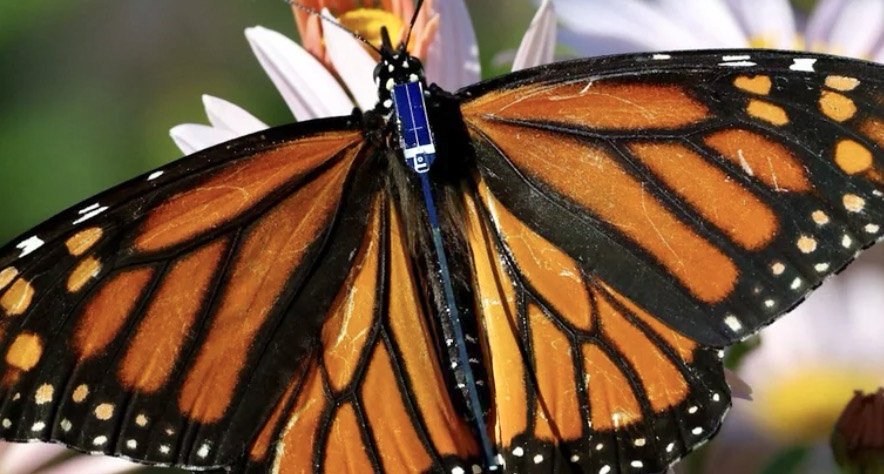
BlūMorpho tracker on monarch butterfly
Swallows in Flight to Yachats (SWIFTY) builds and monitors nesting boxes for Purple Martins. In 2025, Klamath Bird Observatory (KBO) approached SWIFTY to see if they would be interested in tracking some of their birds with a new tag that transmits a low-power radio signal that can be picked up by smartphones. This system then uses the phone’s location information to record approximately where the bird was detected.
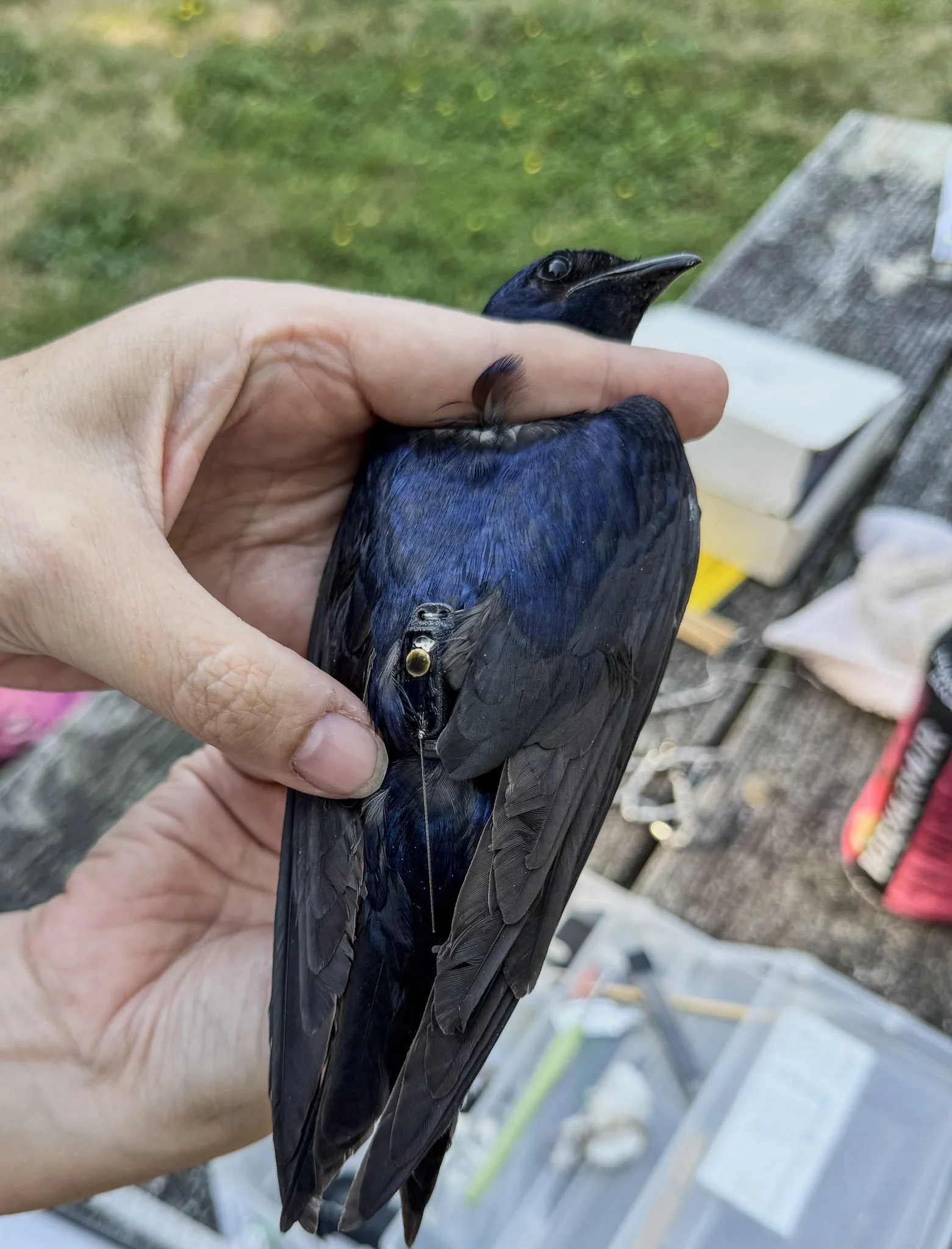
BlūBird tracker on Purple Martin
Developed by Cellular Tracking Technologies (CTT), the first generation of tags named BlūMorpho is light enough to go on a butterfly. In Fall 2025, 400 BlūMorpho transmitters were put on Monarch butterflies. To date these butterflies have been tracked thousands of miles from southern Ontario to Mexico and the Caribbean.
The same year, CTT released the next generation of this technology named BlūBird. Weighing 0.27 grams and more powerful than BlūMorpho, it is still light enough to be carried by small birds like a House Wren (11 grams), while staying under 3% of the bird’s weight—the safety threshold for deploying bird backpacks.
Bird tagging attempts
In early 2026 SWIFTY built and installed 20 Purple Martin nesting boxes designed to enable easy capture. These boxes were located at five different sites near the Oregon coast. Oregon Birding Association and Seven Capes Bird Alliance provided funds for four BlūBird tags.
In mid-July, KBO attached BlūBird tags to three Purple Martins near Waldport and one on the North Fork of the Siuslaw River. Two of the Waldport tags lost their signal in the first few weeks—perhaps a bird died, the tag fell off, or the tag failed. The two tags that are still working are worn by Elise, an adult female from Waldport, and Finn, a subadult male from the North Fork of the Siuslaw River.
Elise and Finn’s 2026 fall migration
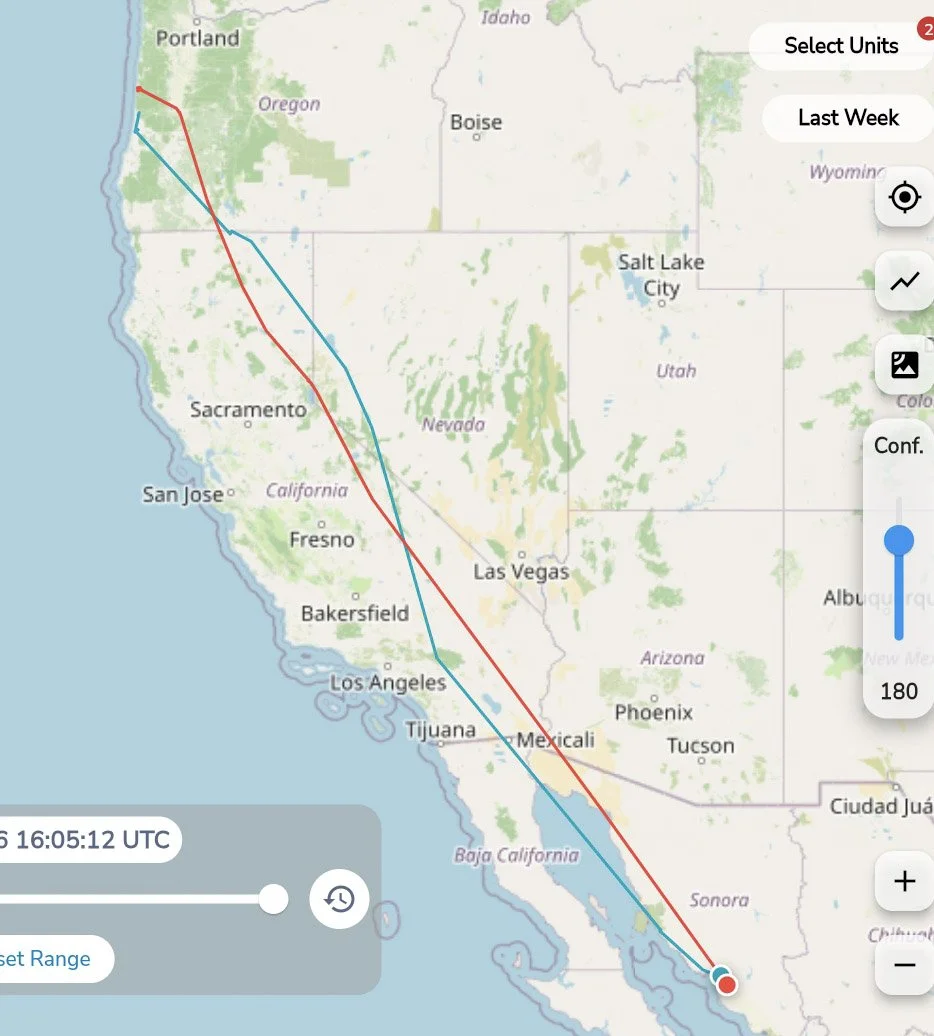
Elise (red) and Finn’s (blue) flight path to Mexico
Both Elise and Finn started their migration in mid-August. Once leaving western Oregon, the two birds chose similar routes down the eastern flank of the Sierras to the head of the Sea of Cortez. They continued along its eastern shore, stopping at an area north of Culiacan, capital of the Mexican state of Sinaloa.
Elise made the 1,500 mile journey from Eugene, Oregon, to Guasave, Mexico, in six days, averaging more than 10 miles/hour. Estimated actual flight speed would be at least twice that, considering the time needed for resting, feeding and orienting. Finn took seven days for the journey.
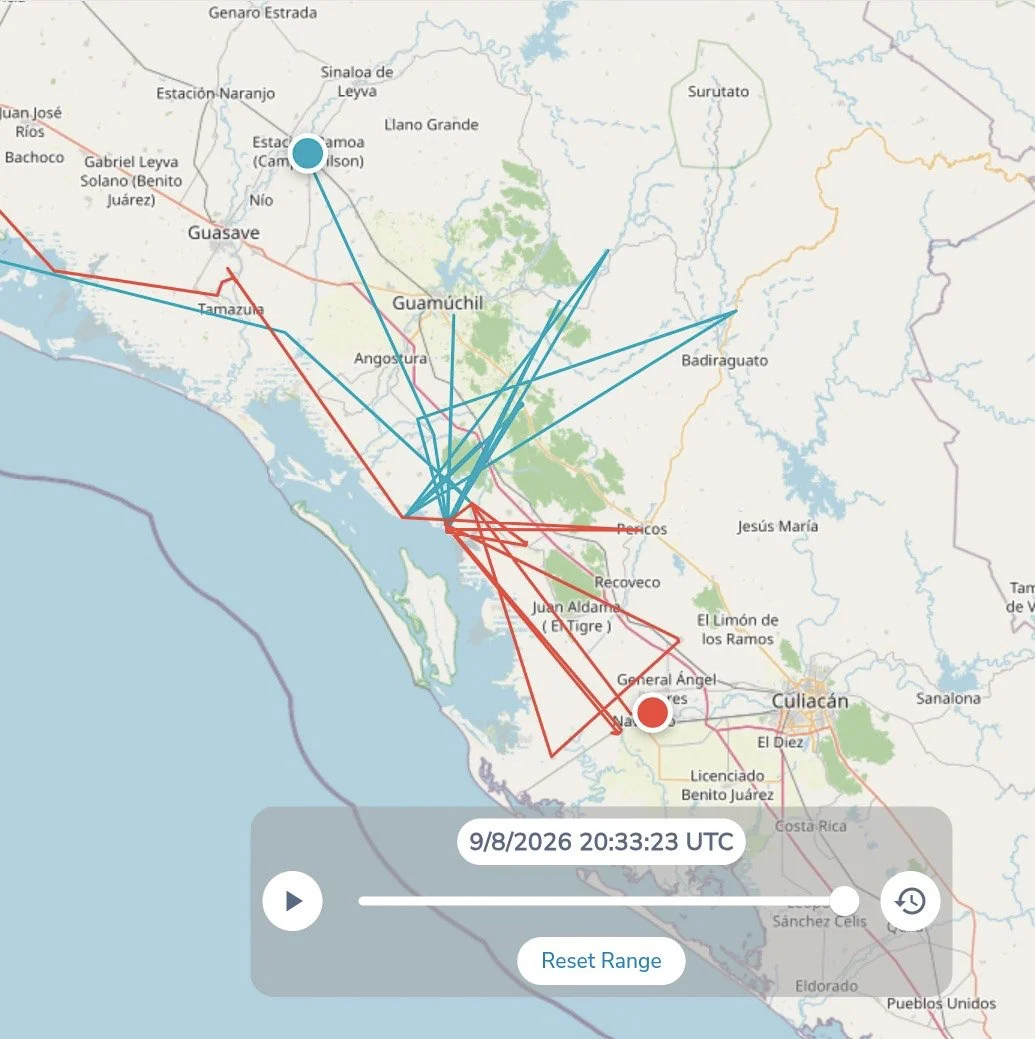
Elise (red) and Finn (blue) near La Reforma, Mexico
As of September 15, 2026, the two birds have been staying in an area approximately 40 miles north of Culiacan. They have been recorded on the same day within blocks of each other in the town of La Reforma, Mexico. Finn and Elise are the first Western subspecies of Purple Martin to carry the BlūBird tags. They are part of the first group of birds in North America to be tagged for the Fall 2026 migration. If successful, this tagging project will be an important step forward in the understanding of Purple Martin ecology and migration. We look forward to Finn and Elise reaching their wintering grounds in Southeast Brazil!
To get updates on where the two birds are in their journey to Brazil see: https://swiftyswallows.weebly.com/puma-migration-202627.html.
Additional Resources
Purple Martin Tracking
http://klamathbird.org/science/projects/western-purple-martin/
https://www.purplemartin.org/migrationtracking/
On the Wings of Roxa
Cellular Tracking Technologies
https://celltracktech.com/pages/project-monarch-collaboration-2025
https://celltracktech.com/products/ctt-blubird