By Aaron Timm, Seven Capes Board Member
Early this year, a scenario unfolded that happens around the world. Our teenage daughter came into my bedroom in the early evening with a shocked and excited look on her face. “A bird hit our house, and I think it’s an owl!” she said.
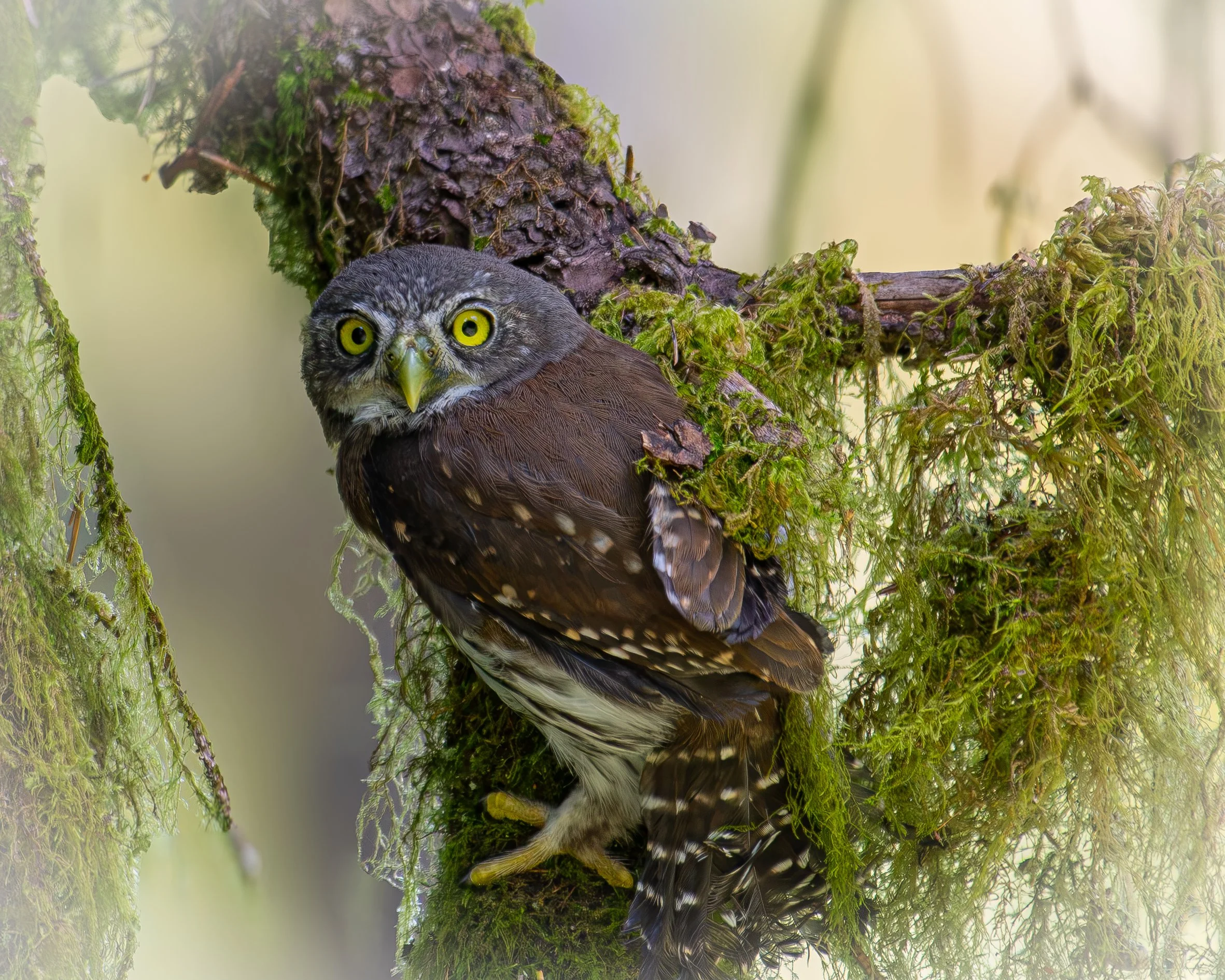
Northern Pygmy Owl
She had been in her room, which is under three Sitka Spruce trees, when she heard the thump of something against the house. Going out the front porch, she found a bird on the ground and placed it on the garbage can by our front door. She then ran upstairs to tell me and her mom the news.
When I got downstairs and out the door, another surprise was waiting. The bird had jumped off the garbage can and was now belly up with one of our pet huskies, Yukon, softly mouthing him. I called the dog off and gently picked up the bird, which not-so-gently grasped my hand with its small talons. It was clearly an owl, about the size of a robin. Although small, I was immediately impressed—and a little worried—as one of its talons broke through the skin on my finger.
The small owl refused to let go in its panic, and I asked my daughter to get a washcloth. With the washcloth put over the owl, I was able to pry its talons gently out of my flesh, and we placed it into a box with a lid for safe keeping. As I mumbled about how much it hurt when the talon pressed into my finger, my daughter said, “It did that to me, too. It wasn’t that bad.”
According to the United States Fish and Wildlife Service, “…over one billion birds collide with glass in the U.S. alone!” Birds also can run into non-glass objects, which is what I believe happened in our case with the owl.
The large trees above our house are great for both nesting birds and owls to practice flying in what is termed “branching,” a practice in which an owl will jump from branch to branch and practice flapping its wings as it gets close to fledging. Owlets, before they can fly, will leave the nest and climb trees with their talons and beaks, but sometimes they fall as they try to fly and glide. I think the young owl must have been branching when it fell and glided into the house.
We were able to identify the bird as a young Northern Pygmy Owl. Since we weren’t sure if it were injured or not (it definitely couldn’t fly at this point, either because of development or injury), we placed it in the box in a quiet, closed room for the night.
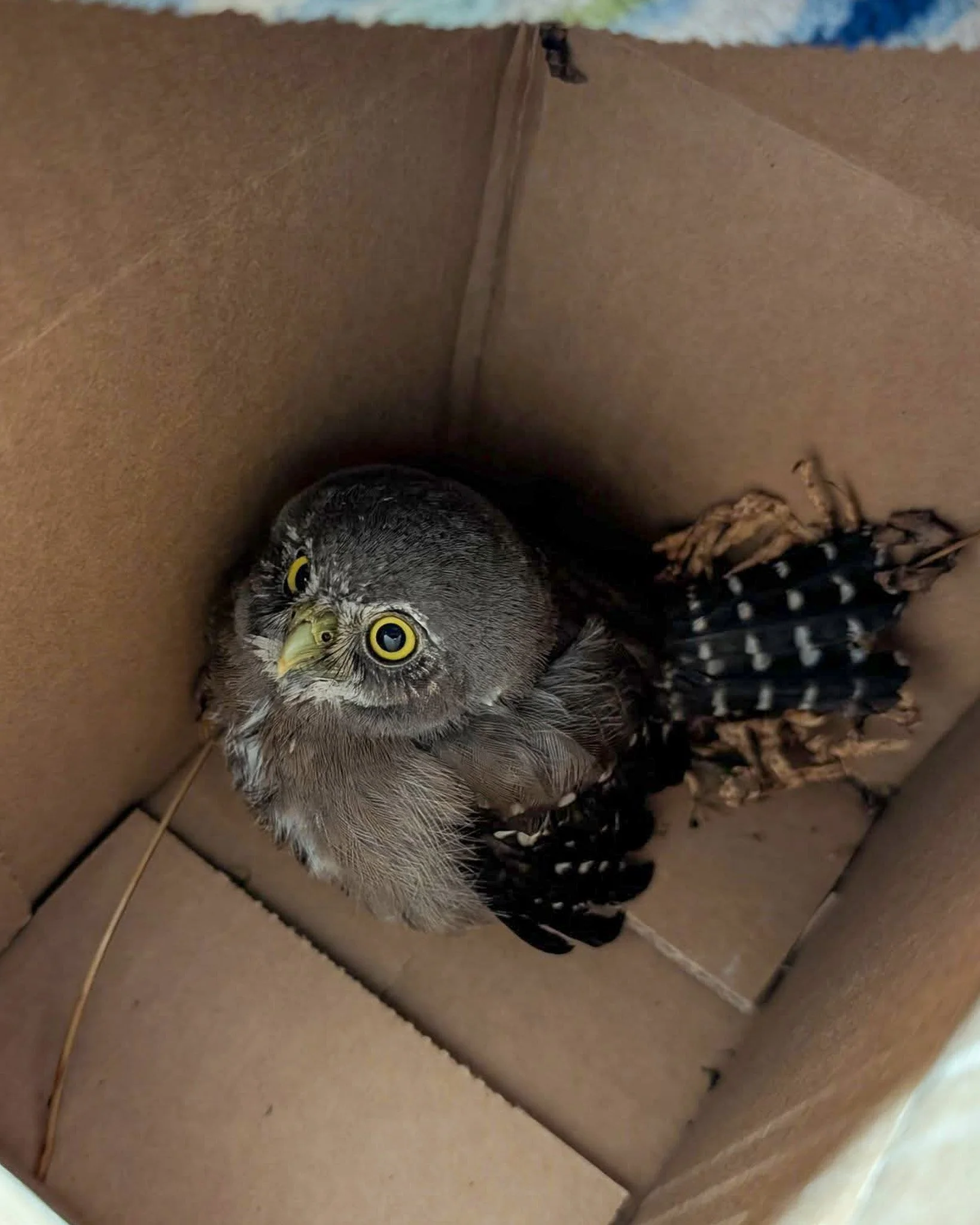
Rescued owl in box
The next day, I was able to contact the Wildlife Center of the North Coast in Astoria, Oregon. Through a network of volunteers and committed employees, a volunteer was found that could meet the owl and me halfway to the rescue center. Before leaving, I received a text from a fellow Seven Capes member who knew of a young gull that needed a lift to the same sanctuary. With the owl, the gull, and my daughter in tow, we drove to meet the volunteer from the rescue center, and the owl was taken to get the help it needed.
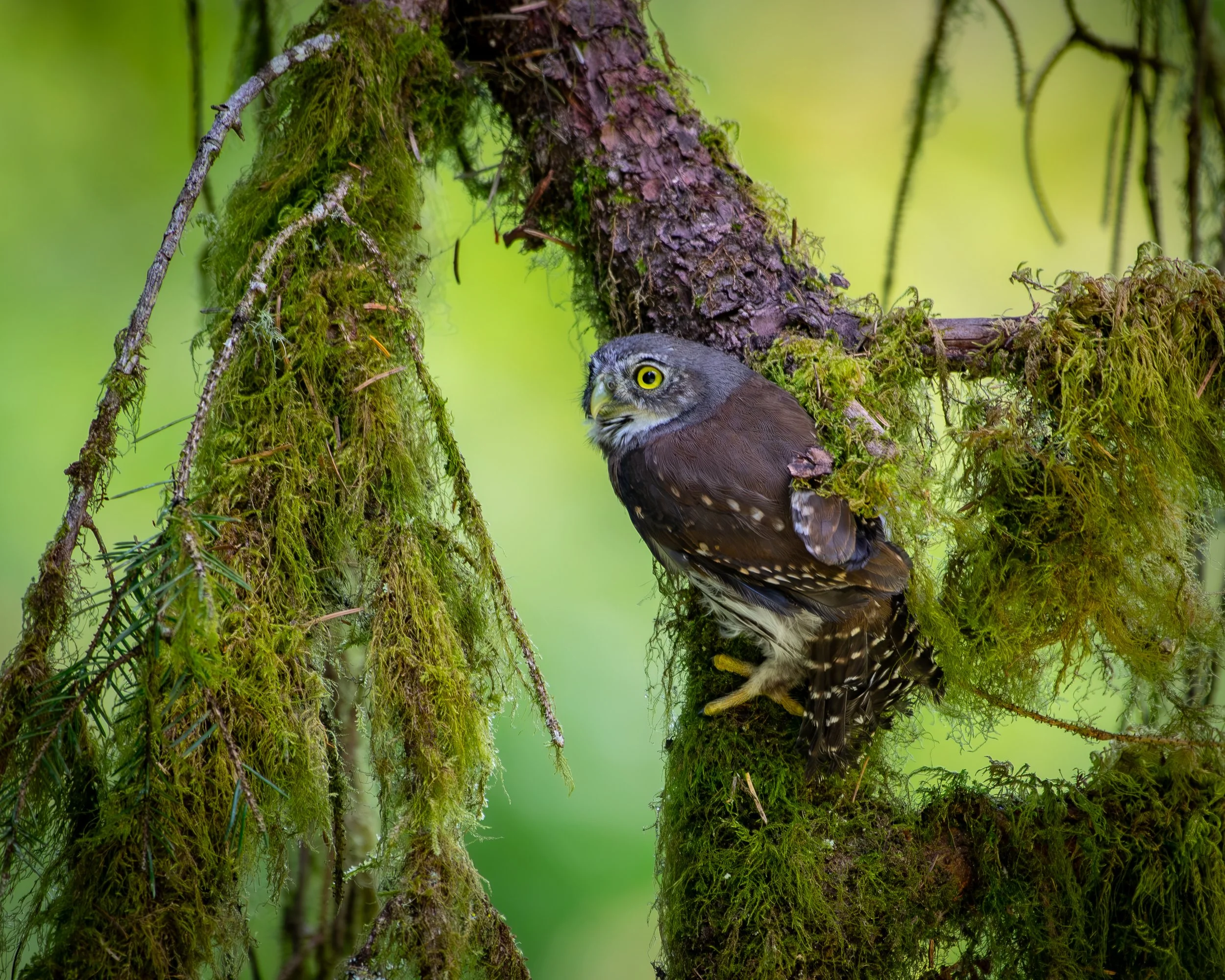
Rescued owl released
About a week later I received a call that the owl was doing great and it was time to release it, ideally as close to the original area of capture as possible. I live in a good section of woods, so we arranged to meet another volunteer driver later that afternoon at my house.
With a small crowd of family, a neighbor, and the volunteer, the owl’s travel box was opened and we patiently waited. It seemed to like its box, but with a little coaxing soon flew out and landed in a nearby tree, giving me some excellent photo opportunities.
While no one wants to see an injured bird, this situation was a learning opportunity. If you find an injured animal, there are several important steps to ensure safety for both the animal and yourself:
If the animal seems sick or could be a danger to you, do not approach or handle it.
If handling an animal, do your best to wear gloves and to cover the animal with a towel or blanket to keep it calm. If it’s a small animal like a bird, place it in a box or animal carrier and keep it dark by placing it in an unlit room or covering the container with a blanket or towel. Be sure the container allows adequate oxygen (a cardboard box with small holes is adequate) and be careful not to leave the animal in an area that might become too hot or cold.
Contact a rescue organization for next steps (see list below).
Do not attempt to give the animal water or food. The rescue professionals will give advice on this and handle it in most situations.
Many products and DIY projects are available to help reduce window strikes. A quick Internet search offers many options, and reputable sites like U. S. Fish and Wildlife and the National Audubon Society also have great information.
Rescue centers throughout our region are available for birds and other animals:
Wildlife Center of the North Coast (native wildlife with a specialty in seabirds) 503-338-0331
NOAA West Coast Stranding Hotline and Marine Mammal Stranding Network (for stranded or injured marine mammals in Oregon, Washington, and California) 1-866-767-6114
Oregon State Police Tipline (injured, stranded, or dead marine mammals) 1-800-452-7888
Chintimini Wildlife Center (wildlife with a specialty in raptors; serves Willamette Valley) 541-745-5324